

If you are wondering how to help a child with ADHD with working memory, the most reliable answer is to stop asking their head to hold the information and move it into the room instead: one step at a time, shown as well as said, sitting where the task actually happens. Capacity grows slowly through routines and self-talk, but the relief comes from lowering the load today.
If you have sent your child upstairs for their shoes and watched them come back with a toy and no shoes, three times in one morning, you are not failing and neither are they. Their working memory ran out before the staircase did.
Working memory is one strand of the bigger picture in our complete guide to executive function skills for kids with ADHD. This post goes deeper on the skill parents ask me about most.
Watch: Tarryn explains this in under eight minutes.
What working memory is, and why ADHD makes it leak
Working memory is the mental workspace that holds information for the few seconds you need to use it. For most children with ADHD that workspace is smaller and more easily tipped over, so instructions and next steps fall out before the body gets there.
Psychologist Russell Barkley describes two kinds: nonverbal working memory (holding a picture in mind) and verbal working memory (the inner voice that talks you through a task). He estimates that children with ADHD trail their peers by roughly 30 to 40 percent in how these skills mature.
This is not an occasional problem. A 2020 study in Neuropsychology by Kofler and colleagues found that between 75 and 81 percent of children with ADHD had working memory below the range seen in children without ADHD. If your child forgets everything, that is the brain difference showing itself, not carelessness.
Working memory grows through childhood and only reaches adult levels in the teenage years; the classroom guide by Susan Gathercole and Tracy Alloway notes that adult capacity is more than double that of a four-year-old. And once information drops out, it is gone. Your child cannot “try harder” to get it back; it has to be re-entered from outside.
What poor working memory looks like at home
At home, a working memory problem rarely looks like a memory problem. It looks like not listening, not caring or not finishing, which is why it so often gets punished instead of supported.
| What you see | What is happening |
|---|---|
| Does the first step, then wanders off | Steps two and three fell out of the workspace |
| Says “what?” the second you finish speaking | The sentence was too long to hold while processing it |
| Knows the rule but does not follow it | The rule was not in working memory at the moment of action |
| Melts down when asked to “just remember” | Shame plus overload, with nothing left for regulation |
Gathercole and Alloway list the same patterns in classrooms: forgetting part of an instruction, abandoning a task halfway, and being described as having a short attention span when the real issue is capacity. If school uses those words, raise working memory at the next meeting.
Repeating, reminding, rescuing. And still running late?
The School Survival Guide is included free until 27 November.
Is poor working memory a sign of ADHD?
Poor working memory on its own is not a diagnosis of anything. It is common in ADHD, but it also shows up with language difficulties, dyslexia, anxiety and plain tiredness.
What matters is the pattern. If forgetting sits alongside trouble with impulse control, attention and getting started, and it is causing real problems at home and school, ask your GP or paediatrician about an assessment. A psychologist or occupational therapist can assess working memory specifically, which helps the school see that the fix is a smaller load, not a louder voice.
How to help a child with ADHD with working memory: reduce the load first
The first job is not to grow your child’s working memory but to shrink what you are asking it to carry. A full workspace cannot take in anything new.
Clear the sensory and motor load
This is the part most advice misses, and as an occupational therapist it is where I start. Working memory shares resources with everything else the brain is managing. A child balancing on a wobbly chair, in a bright noisy kitchen, still working out how to grip the fork, has little workspace left for “and then put your plate in the sink”. Quieter room, feet on the floor, television off while you talk. Each one gives capacity back.
Put the information where the task happens
A reminder given in the kitchen has to survive the trip to the bathroom. A picture checklist beside the toothbrush does not. Under eight, use photos of your child doing each step; for a tween, a short list they helped write. A visual timer does the same job for time: it holds the “how long” so your child does not have to.
Give one step, then wait
One instruction, in a short sentence, close and quiet. Wait until that step is done before adding the next. If you must give two, pair them so they belong together (“shoes and coat”, both at the door). Gathercole and Alloway flag sequences of three or more unrelated items as the point where children with weak working memory start to drop things. The full instruction script is in why your child with ADHD doesn’t listen.
Ask for a playback, not a promise
“Tell me what you’re going to do” checks the instruction landed and moves it into verbal working memory, where your child’s own voice can carry it. “Okay” tells you nothing. A playback in their words tells you everything.
| Instead of | Try |
|---|---|
| “Go upstairs, brush your teeth, get your PE kit and bring down your reading book.” | “Teeth first. Come find me when they’re done.” |
| Calling instructions from another room | Walking over, saying it once, close and quiet |
| “Did you hear me?” | “What’s the plan?” |
Then build capacity, slowly
Working memory does develop, and it is supported less by drills than by habits that reduce the load, plus everyday play that stretches it gently.
Make it a routine, so memory is not needed
A routine is a sequence the body knows, which means working memory can stay out of it. Education specialist Linda Hecker puts it plainly in the Child Mind Institute’s guide to working memory: routines free up mental workspace, and “routines are the goal”. The same five steps, in the same order, in the same place, every morning, will do more than any app.
Practise thinking out loud
Verbal working memory is self-talk, and children with ADHD tend to have less of it running. Model it: “Keys, bag, letter. Keys, bag, letter.” Then invite your child to narrate their own small tasks. It feels silly for a week and then it sticks.
Choose games that load working memory naturally
Card games where you hold what has been played, “I went to the shop and bought” with a growing list, a three-step recipe, Simon Says with two actions. Not a treatment, just low-pressure practice with a parent regulating alongside.
What about brain-training programmes?
Be cautious about anything promising a fix in six weeks. A 2015 meta-analysis of randomised trials by Cortese and colleagues in the Journal of the American Academy of Child and Adolescent Psychiatry found that cognitive training improved working memory on laboratory tests, but once raters did not know which children had trained the effect on ADHD symptoms was small, with no significant change in inattention or hyperactivity, and academic performance did not change. Gains stay close to the tasks practised. Spend the money on a timer and the time on routines.
Your own working memory matters too
You are the family’s external hard drive, and that drive is full. A parent on an overloaded workspace shouts from the kitchen because there is no capacity left to walk over and say it once.
Externalise your own load the same way: one list on the fridge, the same morning order every day, bags packed the night before. A calmer parent gives a child a calmer nervous system to borrow, and a calmer nervous system has more working memory in it. That is co-regulation at work on a skill that looks purely cognitive.
Try this tonight: one thing, one place
Pick a single routine that falls apart every day, usually teeth or bag packing, and run this version for a week.
- Choose the place. Where does the task actually happen? That is where the support lives, not the kitchen.
- Make the list with your child. Three to five steps, photos for younger children, their handwriting for older ones. Stick it at eye level.
- Clear the load. Screens off, lights lower, nothing else asked of them for those ten minutes.
- One step, then playback. “First one is teeth. What’s first?” Wait. Then “What’s next?” pointing at the list, not telling.
- Close the loop warmly. “You did all five from the list” names the skill. Skip the “finally” and the “see, you can do it”.
Expect day two to go badly. By day five most children glance at the list before you prompt, and that glance is working memory being replaced by something more reliable.
Frequently asked questions
Does ADHD affect working memory?
Yes, for most children. The Kofler study above found 75 to 81 percent of children with ADHD had working memory below the typical range. The degree varies from child to child.
Can working memory be improved in a child with ADHD?
Capacity grows with age and the gap often narrows, but the strongest evidence is for changing the demand rather than the brain: shorter instructions, visual supports, routines and a lower sensory load. Brain-training programmes have not reliably improved behaviour or schoolwork in blinded trials.
Do working memory games and apps work?
Family games are good practice and good connection. Paid apps marketed for ADHD have shown limited transfer to real life so far, so treat them as play, not as a plan.
How Nurture ADHD helps
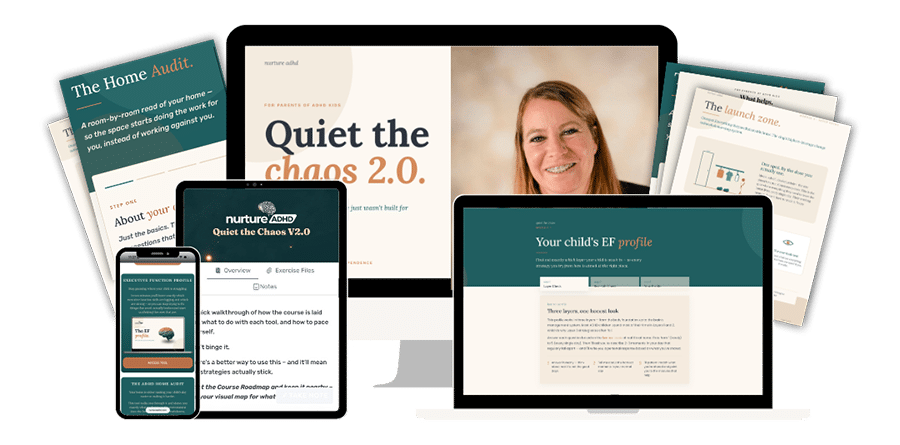
Almost everything here comes down to one principle: a child with ADHD needs the day to carry what their working memory cannot. That is the whole design behind Quiet the Chaos, which shows you how to build mornings, after-school and bedtime routines that hold without you repeating yourself, with the visual supports in the places a child actually uses them.
If you want to start smaller, download the free ADHD Routine Checklist and build your first “one thing, one place” list from it this week.
Repeating, reminding, rescuing. And still running late?
The School Survival Guide is included free until 27 November.
Written by Tarryn Poulton, paediatric occupational therapist (BSc OT, University of the Witwatersrand, Sensory Integration trained), founder of Nurture ADHD and mom to a child with ADHD, based on more than 10 years of clinical work with children with ADHD and their families. This is general information, not medical advice; please speak to your child’s doctor about diagnosis and treatment.